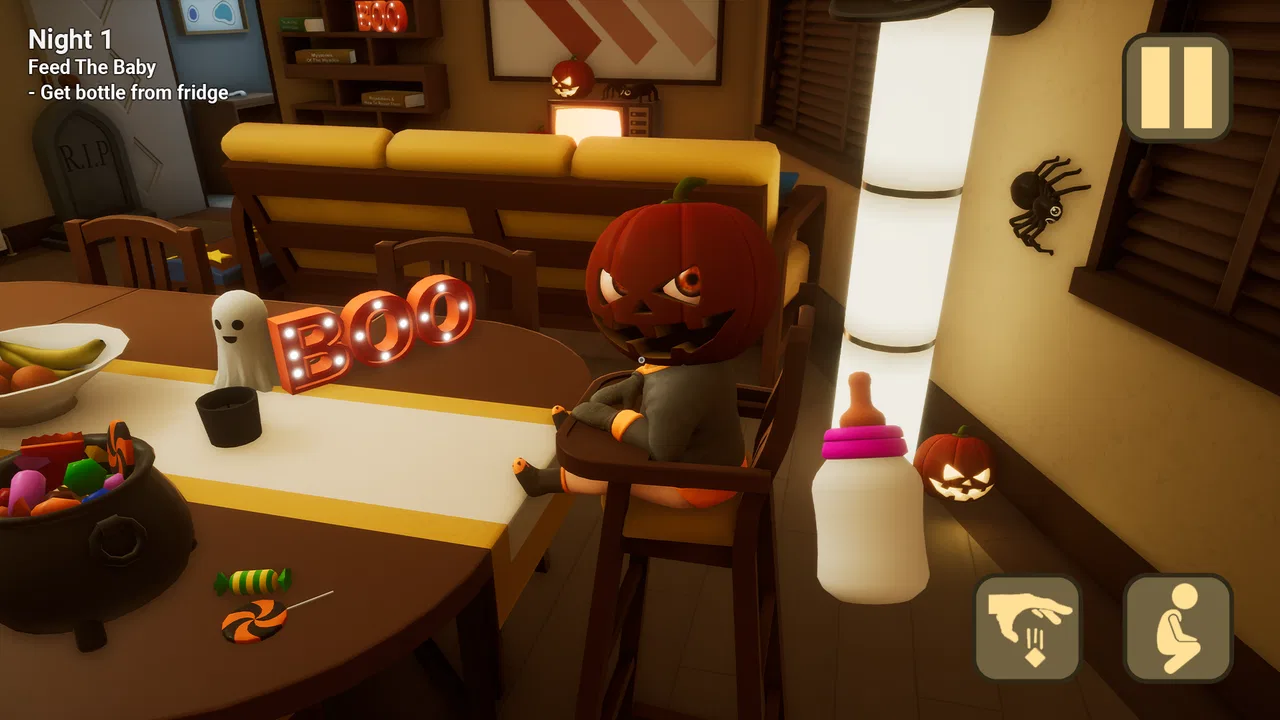
The Baby In Yellow
- 4.3
- Rating
- 100.00M
- Installs
- Free
- Price

 Analysis by App-foxy
Some horror games try to overwhelm me with combat, complicated puzzles, or long story scenes. The Baby In Yellow takes a stranger and more focused route: it turns babysitting into a tense simulation where ordinary care tasks become increasingly unsettling. I expected a quick novelty, but the game works best when I treat the house like a space to observe rather than a level to rush through. Small decisions about where I go, what I check first, and how calmly I respond matter more than reflexes.
Created by Team Terrible, this free simulation game is aimed at Teen players and runs on devices using Android 8.0 or later. It has built a very large audience, with over one hundred million installs and an average rating of 4.2 from around six hundred fifty thousand ratings. Those figures make sense after spending time with it: the premise is immediately understandable, the sessions are approachable, and the unusual contrast between childcare and horror gives it a memorable identity.
Why the babysitting setup creates real decisions
The opening idea is simple enough to explain to a friend in one sentence. I am responsible for a baby, and I need to complete familiar household duties. The discomfort comes from the fact that the child is not presented as a normal, predictable responsibility. The game keeps asking me to perform routine actions while quietly making the environment feel less trustworthy.
You May Also Like

 Blood Strike: 2.5 Anniversary
Blood Strike’s Loadouts Turn Every Drop Into a Tactical Gamble
A close look at Blood Strike’s custom loadouts: how fast access to signature weapons reshapes its battle royale rhythm, rewards preparation, and narrows the gap between fights.

 Pandora - Music & Podcasts
Pandora’s Music Is Easy to Start, but Harder to Recover
Pandora’s strength is its low-effort path from a seed to a station. Its weak spot is how much confidence it asks you to place in connection, setup, and quiet recovery.

 8 Ball Pool
 Is Built on Rivalries, Rematches, and Routine
A close look at the rivalries, rematches, shared routines, and unanswered safety questions that turn a quick pool match into a persistent mobile community.

 Samsung Music
’s Quiet Strength Is Playing What You Already Own
Its reach comes less from spectacle than from dependable access to a personal library. That simplicity is both the app’s strongest retention engine and its ceiling.

 AccuWeather: Weather Radar
AccuWeather Review: A Quick, Clear Forecast for Everyday Decisions
For everyday plans, the best forecast is the one you can understand quickly. AccuWeather makes rain timing, radar, and local conditions easy to act on, with a few trade-offs.

 Hill Climb Racing
Why Hill Climb Racing Still Turns Crashes Into One More Run
A tiny car, a bumpy hill and one more upgrade: Hill Climb Racing keeps resurfacing because its simple chaos makes every near-miss feel personal.
More From Our News Desk
View All News


That contrast creates the main decision space. I can focus on completing the visible task as quickly as possible, or I can pause to look around, understand the room, and think about what might have changed. Speed feels useful when I want to preserve momentum, but observation is often the better habit when the atmosphere starts to shift. The game does not need a large inventory or a complicated skill tree to create pressure; it uses uncertainty and responsibility instead.
I found that the most effective approach was to establish a mental route through the house. Before moving the baby or starting a new chore, I paid attention to nearby doors, furniture, and the next place I would need to visit. This sounds basic, but it reduces the feeling of being lost when the mood changes. Planning the next two actions is more valuable than blindly sprinting through the current one.
The house also works as part of the decision-making. It is not just a backdrop for frightening moments. Familiar rooms become reference points, and that familiarity makes interruptions more noticeable. A quiet trip between rooms can feel safe until I begin wondering whether I am remembering the space correctly. That tension gives the simulation side more purpose than a simple sequence of jump scares.
One useful habit is to treat every completed task as a checkpoint for attention, not as permission to relax. After feeding, changing, or settling the baby, I would take a brief look at my surroundings before immediately following the next instruction. This does not turn the game into a puzzle spreadsheet, but it helps me avoid reacting late when the situation becomes less ordinary.
How the everyday tasks become the horror
The strongest part of the design is that the chores are not separate from the fear. Carrying out childcare duties creates a rhythm, and the rhythm makes disruption effective. If the game began with constant chaos, I would adapt quickly. Instead, the familiar work gives me a baseline, so even a small change in the baby’s behavior or the room’s mood feels important.
This is also why the game can appeal to people who do not usually play traditional horror. I do not need to learn combat controls or memorize a large map. The basic objective is easy to understand, while the emotional pressure comes from having to continue acting responsibly when I would rather step away. Players who enjoy environmental tension and short narrative scenarios may find more here than players looking only for action.
There is a trade-off, though. Anyone expecting a deep childcare simulator may be disappointed. The babysitting theme is a framework for horror, not a detailed recreation of real childcare. The routines are valuable because they support pacing and atmosphere, not because they model every practical part of looking after a child.
Likewise, the game is not the right choice for someone who wants a fully open-ended sandbox. My choices influence how I move through each situation, but the experience is still guided. I am making decisions inside a designed horror scenario rather than building my own household story. That structure helps the game stay focused, but it limits experimentation compared with broader simulation games.
Risk, reward, and the cost of rushing
The risk-and-reward balance is mostly psychological. Moving quickly can make a task feel safer because I spend less time in an uncomfortable room. At the same time, rushing can leave me less prepared for the next instruction or surprise. Slowing down gives me more awareness, but it also means sitting with the tension instead of escaping it.
I would not describe the game as a test of perfect timing. It is closer to a test of composure. When I panic, I make simple navigation mistakes, overlook obvious surroundings, and lose track of what I was supposed to do. When I keep a steady pace, the same situation becomes easier to read. That makes the horror personal in a useful way: my reaction changes how difficult the scene feels.
A realistic example is playing late in the evening with headphones while trying to finish a short session before bed. I might begin by treating the chores as a quick checklist, but the sound design and the empty spaces encourage me to stop multitasking. If I rush because I am distracted, I am more likely to miss a visual cue or become startled by something I should have noticed. If I give the game my full attention, the session feels more controlled, although also more intense.
For that reason, I recommend playing in short, focused stretches rather than using it as background entertainment. The game benefits from concentration, and its scares lose some impact if I am switching between messages or watching another screen. A quiet room helps, but players who are sensitive to horror should also remember that the innocent-looking premise does not make the experience gentle.
The Teen content rating is important here. The game’s discomfort comes from the collision between a vulnerable-looking baby and supernatural horror, so the subject matter may bother some players even if they are comfortable with milder haunted-house games. I would not hand it to a young child simply because the central character is a baby.
Adapting instead of memorizing a single route
My first instinct was to search for the fastest sequence of actions. That works only up to a point. The better adaptation is learning the game’s tone and responding to what is happening now rather than assuming that yesterday’s route will always feel safe. The experience rewards attention to context more than a rigid speedrun mentality.
When I replayed sections, I became better at separating necessary movement from nervous movement. Necessary movement takes me toward the current objective. Nervous movement sends me back and forth because I am unsure what I saw. Recognizing that difference helped me stay calmer and made the house easier to navigate.
Another practical adjustment is to keep the camera deliberate. Constantly turning around can make the environment harder to understand and can increase my own confusion. I found it more useful to scan a room in a consistent direction, identify the important objects, and then move. This is a small technique, but it turns an anxious search into a repeatable process.
The game also benefits from accepting that not every moment needs an immediate explanation. Horror often becomes weaker when I try to solve the atmosphere too quickly. I can notice something strange, continue the task, and wait for the game to clarify its purpose. That patience is a form of counterplay: instead of letting uncertainty dictate my movement, I choose when to investigate and when to proceed.
Players who dislike being startled may want to lower the volume or avoid headphones on their first attempt, although that reduces some of the atmosphere. Players who enjoy audio-driven tension should do the opposite and give the sound room to work. The best setup depends on whether the goal is to explore the story comfortably or to maximize the horror effect.
What gives it staying power after the first surprise
The game’s depth is not the same as the depth found in a long management simulator. There are no broad economic plans, character builds, or large production systems to master. Its longer-term appeal comes from noticing more, handling pressure better, and revisiting the experience with a different attitude.
On a first playthrough, I was mainly trying to understand what the game wanted from me. Later, I paid more attention to pacing, room transitions, and the way ordinary instructions frame the next unsettling moment. That shift from survival-by-confusion to deliberate observation is the main form of progression.
This makes it well suited to several kinds of players. A newcomer can understand the basic goal without reading a manual. A horror fan can look for environmental details and compare how different choices affect the feeling of a scene. A group of friends can take turns and discuss whether a strange event was noticed early or simply revealed at the right time.
It is less suitable for a player who needs constant novelty through complex systems. Once the central trick is familiar, the experience depends more on atmosphere and replaying with better awareness than on unlocking a completely different play style. If I want a game that gives me dozens of hours of evolving strategy, I should choose a deeper simulation or a more expansive horror title instead.
The free price makes experimentation easy, but the game includes in-app purchases priced at $3.49 per item. I would approach those purchases as optional extras rather than part of the reason to try the core experience. The important question is whether the basic horror loop works for me; if it does not, spending more will not change the underlying style of play.
Version 2.3.3 is the current version I reviewed, and the game has been available since March 9, 2021. That history helps explain why the concept feels established rather than like a rough experiment. Still, mobile performance and comfort can vary by device, so I would make sure the phone has enough free attention and battery for a focused session rather than expecting it to be a casual idle game.
Who should download it, and who should skip it
I would recommend it to players who enjoy short horror scenarios, unusual premises, and games where atmosphere matters more than combat. It is especially good for someone who wants a clear objective but does not want to learn a complicated control scheme. The babysitting setup also makes it easy to share with a friend: one person can play while the other suggests where to look, although the person holding the phone should make the final decisions.
I would skip it if I am looking for a peaceful family simulation, because the childcare framing is deliberately unsettling. I would also skip it if I dislike guided experiences, repeated tension, or horror built around an apparently harmless character. Players who want direct action may find the walking, observing, and task-based structure too restrained.
Compared with a typical life simulation, this game replaces customization and long-term planning with suspense. Compared with a conventional haunted-house game, it gives me a stronger sense of responsibility because I am not merely exploring an abandoned location; I am trying to complete duties while something feels wrong. Compared with an action horror game, it offers fewer tools for fighting back, which makes preparation and calm observation more important.
That comparison also clarifies its best use case. I would choose it for a compact evening horror session, a mobile game night, or a quick introduction to atmospheric horror. I would not choose it as my main game for a long commute if I need something relaxing, because the tension requires attention and may make the trip feel more stressful rather than more enjoyable.
My strategy verdict after living with the strange routine
The Baby In Yellow succeeds because it understands that a familiar responsibility can be more disturbing than an obviously dangerous mission. Its strongest decisions are about pacing: it lets me settle into routine, then asks me to keep functioning when routine no longer feels reliable. I enjoyed the way simple observation became a meaningful advantage, even though the game never turns that idea into a complex strategy system.
Team Terrible has made a simulation game with a very specific identity. It is free, available for players on Android 8.0 and later, and its Teen rating accurately signals that the cute premise should not be mistaken for a children’s title. The huge install count and strong average rating reflect its accessibility, but they should not be read as a promise that every horror preference will fit it.
My final advice is to play slowly enough to notice the environment, but not so slowly that you turn every movement into panic. Keep a simple mental plan, check the room before starting the next task, and accept that uncertainty is part of the design rather than a problem to eliminate immediately. Those habits make the experience more readable and let the horror build naturally.
If I wanted a deep, realistic babysitting simulator, I would choose something else. If I wanted a large horror adventure with combat and extensive exploration, I would also look elsewhere. But for a focused mobile game that turns familiar chores into an uneasy test of attention, this is an easy recommendation. Its real strength is not the shock alone; it is the way responsibility keeps me moving toward the next task when every instinct says to stop.
FAQs for The Baby In Yellow
01What is the main objective of The Baby In Yellow?
The Baby In Yellow is a horror-themed game where you play as a babysitter tasked with taking care of a peculiar baby. The main objective is to complete a series of babysitting tasks while dealing with eerie and supernatural occurrences. Players must navigate through various unsettling scenarios and uncover the mysteries surrounding the baby.
02Is The Baby In Yellow suitable for children?
The Baby In Yellow is not suitable for young children due to its horror elements and unsettling themes. The game is designed to evoke suspense and fear, making it more appropriate for older teenagers and adults who enjoy horror games. Parents should consider the game's content before allowing younger players to engage with it.
03What platforms is The Baby In Yellow available on?
The Baby In Yellow is available for both Android and iOS devices, making it accessible to a wide audience of mobile gamers. It can be downloaded from the Google Play Store for Android users and the App Store for iOS users. Ensure your device meets the necessary system requirements for optimal gameplay.
04Does The Baby In Yellow require an internet connection to play?
The Baby In Yellow does not require a constant internet connection to play. Players can enjoy the game offline, making it convenient for those who prefer playing without data or Wi-Fi. However, an initial internet connection is needed for downloading the app from the respective app stores.
05Are there in-app purchases in The Baby In Yellow?
The Baby In Yellow is free to download and play, but it may include optional in-app purchases. These purchases can enhance the gaming experience by unlocking additional content or features. Players should check the app's store page for details on any available purchases and manage their settings accordingly to avoid unintended transactions.
Pros
- Immersive horror atmosphere.
- Simple and intuitive controls.
- Engaging storyline twists.
- Free to download and play.
- Frequent updates and improvements.
Cons
- Short gameplay duration.
- Limited replayability value.
- Graphics could be improved.
- Some jump scares are predictable.
- No multiplayer mode available.

The Baby In Yellow
Gallery